
Oktopus
Bewusstseinsforschung
© 2016
- 2026
Basiswissen
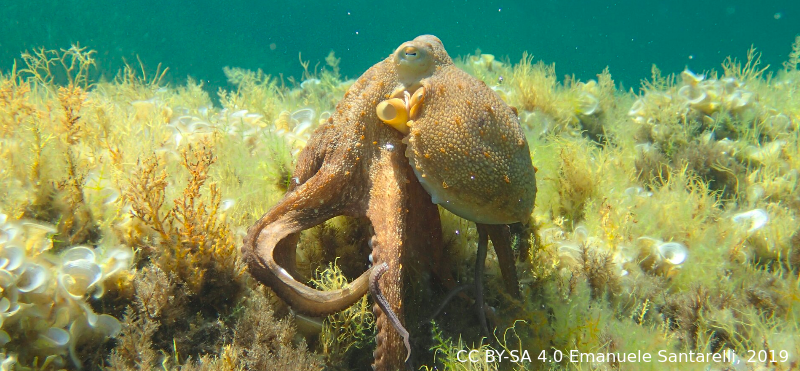
Das Wort Oktopus heißt wörtlich so viel wie Achtfüßler. In der Gastronomie steht Oktopus ganz allgemein für irgendeinen Tintenfisch. In der Biologie bezeichnet das Wort Oktopus einmal irgendein Tier aus der Ordnung Octopodidae (echte Kraken). Es kann aber auch für die Gattung Octopus in der Ordnung Octopoda stehen. Noch spezieller steht es oft für die einzelne Tierart des gewöhnlichen Kraken. Es gibt zahlreiche Indizien dafür, dass Oktopusse ein ausgeprägtes Bewusstsein haben [1] und möglicherweise auch träumen [2] [3]. Da Oktopusse eine stark dezentrale Informationsverarbeitung haben [4] sind sie auch ein Modell-Kandidat für eine Hive mind [Schwarmintelligenz] [5]👉
Fußnoten
- [1] Other Minds: The Octopus, the Sea, and the Deep Origins of Consciousness. New York: William Collins. 2016. ISBN 978-0-374-22776-0. OCLC 957696590.
- [2] Sylvia Lima de Souza Medeiros et al.: Cyclic alternation of quiet and active sleep states in the octopus. In: iScience Volume 24, Issue 4, 23 April 2021. DOI: https://doi.org/10.1016/j.isci.2021.102223
- [3] Zum Träumen: "Recent octopus studies also show evidence for an alternation between active and quiet sleep, and skin patterning sequences during bouts of active sleep resemble those seen when the octopuses are awake. This suggests dream-like episodes". In: Peter Godfrey-Smith; Inferring Consciousness in Phylogenetically Distant Organisms. J Cogn Neurosci 2024; 36 (8): 1660–1666. Siehe auch 👉 Gradualismus (Bewusstsein)
- [4] "180 million neurons in the central brain are connected with more than 40,000,000 neurons in each of the eight arms via relatively few efferents (~ 32,000) and afferents (~ 140,000). According to Graziadei and Young (Young 1971), about 380,000 motor neurons are distributed along the neuropil of the MC of each arm. A crude calculation suggests that roughly 1500 motor neurons innervate a 1-mm-long section of the arm (in an average arm of 250 mm length) [...] This anatomical organization suggests that much of the sensory information and motor commands are processed in the peripheral nervous system of the arm". In: Zullo, L., Eichenstein, H., Maiole, F. et al. Motor control pathways in the nervous system of Octopus vulgaris arm. J Comp Physiol A 205, 271–279 (2019). https://doi.org/10.1007/s00359-019-01332-6
- [5] "They [die acht kleineren Gehirne in den Beinen] exhibit some integrated behavior, where it appears that the organism is acting as a whole, and some fragmented behavior, where it appears that parts are acting independently of each other." In: Roelofs, L., Sebo, J. Overlapping minds and the hedonic calculus. Philos Stud 181, 1487–1506 (2024). Siehe auch 👉 Hive mind
- [6] Die Koordination der Arme eines Oktopus scheint zueinem guten Anteil außerhalb des Gehirns zwichen den Armen selbst geregelt zu werden: "Mechanostimulation of one arm generates spiking in the nerve ring and in other arms. Activity in the nerve ring decreases with distance from the stimulated arm. Spontaneous activity with a range of spiking patterns occurs in the axial nerve cords and the nerve ring. These data show rich interarm signaling that supports arm control and coordination occurring outside of the brain." In: Chang W, Hale ME. Mechanosensory signal transmission in the arms and the nerve ring, an interarm connective, of Octopus bimaculoides. iScience. 2023 Apr 24;26(5):106722. doi: 10.1016/j.isci.2023.106722. PMID: 37216097; PMCID: PMC10192654.
- [7] Manchen Arten des Oktopus laufen auf zwei Beinen auf dem Boden und imitieren treibendes Material als Tarnung: "Two species of octopus walk on two alternating arms using a rolling gait and appear to use the remaining six arms for camouflage. Octopus marginatus resembles a coconut, and Octopus (Abdopus) aculeatus, a clump of floating algae. [...] Each arm was on the sand for more than half of the stride, qualifying this behavior as a form of walking." In: Christine L. Huffard et al.: Underwater Bipedal Locomotion by Octopuses in Disguise. Science307,1927-1927(2005). DOI:10.1126/science.1109616